



Spatial And Environmental Planning
Background
The Department of Spatial & Environmental Planning established in 2022 is a merger of two former departments- Department of Environmental Planning & Management (established in 1991) and Department of Urban & Regional Planning (established in 2016). It houses four internationally renowned programmes approved by the Commission of University Education in Kenya. This programmes include; Bachelors in Urban and Regional Planning, Bachelors in Environmental Planning and Management, Masters in Environmental Planning & Management and Doctor of Philosophy in Environmental Planning & Management. The Department is in advanced stage in Curriculum development of Interdisciplinary Masters in Resource Efficient Cities (IMAREC) which will be offered in collaboration with Universities in Egypt, Mexico, Germany and Indonesia. The Programme once in place will provide students opportunity for exchange learning both physically and virtually with Ain Shams University(ASU, Egypt), TH Koln (Germany), Universidad Autónoma de San Luis Potosí (Mexico) and Universitas Gadjah Mada (Indonesia).
The programmes in this Department are highly competitive and offers its graduate a cutting edge advantage in new dispensation of Knowledge economy and sustainability Science. Our graduates are professionals who thrive in a transdisplinary work environment. They find Employment in Private and Public Sector. Majority of our Graduates are employed by National Environment Authority (NEMA), County Governments, Ministry of Environment, UNEP, UNDP, World Bank, IFC, WHO, African Development Bank, Commercial Banks, All state Departments and Ministries with Environmental and Planning Unit/ Departments. Graduates from the Urban & regional Planning programme are recognized and certified professionally as physical planners while graduates from Environmental Planning & Management are recognized and certified as Environmental Consultants Registered by NEMA and planning associations.
Internal Links
The Department links with all Schools, Directorates and Departments which require its professional expertise within Kenyatta University. Currently the Department Supports Kenyatta University Green Education HUB and Center for Education & Sustainable Development among others.
External Links
The Department has formal links with the Regional Centre for Mapping Resources for Development (RCMRD), Environmental Institute of Kenya, Kenya Institute of Planners, National Environmental Management Authority (NEMA), East Africa Planning Schools, Kenya Forestry Research Institute (KEFRI) Kenya National Highways Authority (KeNHA), State Departments of Housing & Urban Development, African Center for Technological Studies (ACTS), International Centre for Insect Physiology and Ecology (ICIPE), Council of Governors Secretariat, United Nations Environmental Programme (UNEP), World Agroforestry Centre (WAC/ formerly ICRAF), French National Institute for Sustainable Development (Institute de Recherche Pour le D’eveloppement (IRD), Department of Urban & Regional Planning is an associate partner in the Bayreuth-Bordeaux-Porto consortium on the Erasmus Mundus Joint Master Degree (EMJMD) project entitled “European Interdisciplinary Master African Studies (EIMAS) among others.
Environmental Planning and Management (EPM) Programmes
Background
These programmes were formerly housed in the Department of Environmental Planning & Management founded in 1991 in the then Faculty of Environmental Studies. It became the first Department in Kenya to offer a Bachelor of Environmental Planning and Management (BEPM), a transdisciplinary programme which envisions mainstreaming of environment in all spheres of the economy through roburst planning and Management. The programme combined environmental planning and physical planning, making it a pioneer in this field. Since 1993 the programme boasts of distinguish Scholars who are still actively involved and have contributed in capacity building young generation scholars currently serving actively in the programme in both teaching and Research. In 2000 Master of Environmental Planning and Management (MEPM) programme was introduced. The first class attracted nine students and currently it has over 60 active postgraduate students and has graduated over 100 students who are serving in various sectors of the economy nationally and internationally. This Programme has consistently attracted students from Environmental Studies, urban and regional planning, architecture, engineering, survey, geography, sociology, agriculture, and the natural sciences among others. The synergy between these students has made the programme very dynamic, interesting and enriching for those who enrol in it. The Department has a vibrant PhD programme which has received recognition internationally. It has trained member of staff in universities in Subsaharan Africa region. The programme has graciously benefitted from DAAD: German Academic Exchange Service which has funded an over 35 In country/ In region students in this programme from 2015 to date. Currently there about 30 doctorate students at various stages of research. Through the Graduate school, staff in the programme collaborates actively with other institutions of higher learning in supervision of postgraduate students.
Rationale of Environmental Planning and Management
During the Earth Summit in Rio De Janeiro, Brazil, in 1992 member states of the United Nations committed themselves to the principles of sustainable development (Agenda 21) both at the nation state and global levels. Sustainable environmental management is a key facet of Agenda 21. Following the Earth Summit several countries initiated the process of implementing Agenda 21. In the case of Kenya, the first National Environment Action Plan (NEAP) and Environmental Management and Co-ordination Act (EMCA) were prepared in 1994 and 1999 respectively. The Kenya government established the National Environment Management Authority (NEMA). Environmental management efforts are supported by various sector legislations, for example Physical Planning Act (1996), Urban Areas and Cities Act (2011), County Government Act (2012), Water Act of 2016, Mining Act Cap 306, Forest Act Cap (2005), Maritime Zones Act Cap 371 and Agriculture Act Cap 318 among other relevant sectoral laws.
The establishment of the EPM programmes at Kenyatta University was part of the local actions aimed at effectuating Agenda 21 through training and research. The programmes are aligned to the aspirations of Sustainable Development Goals, Africa Agenda 2063 among other international, regional, National and Local Policies and Plans. The EPM programmes main aim is to produce qualified and highly effective personnel in environmental planning & management who can undertake research, teach, Consult and mainstream environmental concerns in all facets of the economy. This is in realization that highly trained manpower is critical in the implementation of aforementioned plans, policies and laws.
Vision Statement
To be excellent programmes which promote research, training and dissemination on environmental planning and management issues.
Mission
The programmes commits to continuous improvement in the quality of training and research in environmental planning and management; driven by highly qualified, competent and motivated staff and adequate facilities; and inspired students.
Identity Statement
Leading programmes in provision of effective training and research on planning and management of environmental resources, human settlements and land uses for sustainable development in Kenya and beyond
Guiding theme
Mainstreaming environmental concerns in the planning and management process as a central process towards attaining sustainable development and committed to high quality training and research on environmental planning and management.
Goal
The goal of EPM programmes is to integrate aspects of the: region; its sub units: the rural and the urban environments; within a holistic analytical approach to address environmental challenges of the development process that cut across the physical, social and economic spectra.
Objectives
- To equip students with knowledge, skills and techniques for environmental planning and management.
- Undertake research and disseminate results through publications, seminars, workshops etc.
- To prepare students to understand and address complexities of nature and man's interaction with it.
- To offer the student opportunities to develop analytical and problem solving skills.
- To produce qualified environmental planners, managers and decision-makers.
Careers Options in EPM
EPM graduates are prepared to serve as Environmental Planners, Environmental Managers, Sustainability Officers, Environmental Officers, Climate change Adaptation & Mitigation Experts, Environmental and Social Safeguards officers, Change Management Officers among many other portfolios that require mainstreaming of environmental considerations in development projects. Currently the public service commission classifies EPM graduates under the scheme of service for Environment Officers. The graduates also serve in private sectors and NGOs at international, national & Local Level.
Bachelors of Science Urban and Regional Planning (URP) Programme
Background
During the last four decades, Kenya has witnessed rapid urban growth rates of around 5%, which have seen the urban population rise from 8% at independence to 27.51 percent in 2019. It is projected that about 50% of the Kenyan population will be urbanized by the year 2030. About 70% of those residing in urban areas live in informal settlements lacking basic infrastructure and services, a situation that is likely to deteriorate in the absence of innovative planning solutions and adequate investment in infrastructure and services.
The country has made efforts to train skilled manpower in spatial planning and urban management, but the rapid growth in demand has far exceeded supply. This in part explains pathetic urban and regional systems, which calls for reconfiguration of skills development to better respond to growing challenges. The need to sharpen training and research in spatial planning while deepening specialization in areas such as urban and regional forms and functions is even more urgent. We need to train specialists in spatial planning and urban management that are well grounded in both theoretical and empirical analysis of planning approaches and processes as well as resulting forms and functions in the face of globalisation. Such specialists should be able develop innovative solutions to planning and environmental problems while taking cognisance of planning history and the emerging African spatial forms. This becomes important because of the failures of the western models to effectively and efficiently address the spatial planning and urban management challenges
in the country.
Globally, Agenda 21 emphasizes the central role of well-planned human settlements for sustainable development. Goal number one states that “human beings are at the centre of concerns for sustainable development. They are entitled to a healthy and productive life in harmony with nature”. Locally, the national spatial plan and the national urban policy stress the need for comprehensive and integrated spatial planning but decry the lack of skilled capacity in planning. The Constitution of Kenya 2010 Article no. 42 guarantees the right of every citizen to a clean and healthy environment which is the main goal of the spatial planning and urban management.
Professional Affiliation and Accreditation
The Kenya Institute of Planners (KIP) is the professional body that articulates the goals of physical/ spatial/land-use planners in Kenya. The Architectural Association of Kenya (AAK) has a planning chapter that caters for Architect planners. Regionally, The Department will be affiliated to the African Association of Planning Schools (AAPS) is a regional association for schools of planning which aims at quality training, research and collaboration in curriculum development and peer reviews. AAPS is also a member of the Global Association of Planning Schools (GPEAN). Internationally, the department will also collaborate with the Commonwealth Association of Planners, The Royal Town Planning Institute, The American Association of Planners among others for professional peer review and exchange of planning knowledge and experiences. The registration and licensing for planners in Kenya is conducted by the Physical Planners Registration Board (PPRB). The board is mandated through the Physical Planners Registration Act, (Cap no.3 of 1996) to regulate the training and practice of the planning profession.
Career Options in URP
Graduates from programs in this department will be employed in both the public and private sector as physical planners, spatial analysts, land-use planners, urban planners, project managers among other professionals in national and county governments. Other opportunities for work exist in private consultancy after professional registration and licensing by the PPRB.
Goal of the Programme
The Urban & Regional Planning programme intends to train well balanced planners that will be in a position to face contemporary planning challenges at any scale. The programme seeks to ensure that its goals are in line with the requirements of professional bodies affiliated with the profession. This will ensure that its graduates are accredited and recognized within the different organizations.
Course Requirements & Costs
Bachelors in Environmental Planning & Management
Bachelors of Science in Urban & Regional Planning
Academic Staff
- Prof. Caleb Mireri
- Prof. Onywere Simon Mang’erere
- Prof. Sammy C. Letema
- Prof. Aggrey Thuo
- Dr. Peter Kamau
- Dr. Laji Adoyo
- Dr. Christine Lucy Majale
- Ms. Eunice Muthoni Kumunga
- Dr Godwin Opinde
- Dr. Patricia Wanjiku Mwangi
- Dr. Purity Muthoni
- Dr. Jackson Kago
- Mr. Julius Maina Waititu
- Mr. Charles O. Mong'are
- Mr. Wilson Nyaoro
- Mr Edwin Wamukaya
- Mr. Mohamed S. Dekow
- Ms. Carolyn M. Getao
- Mr. Isaac A.C. Kirui
- Mr. John Kimani
- Ms. Mildred Murende Ambani
- Ms. Dinah Kinya
Technicians
- Ms. Elizabeth Maende
- Mr. Bolly Echessa
- Mr. Martin Karugu
Specializations
The Department of Spatial and Environmental Planning has 22 members of academic staff and 3 Technicians. PhD holders and comprise of 3 Associate professors, 2 senior lecturers and 13 lecturers and 3 tutorial fellows. The staff members have qualifications in the following areas:
· Spatial Planning
· Environmental Resources Management (Land, water, air)
· Environmental Governance
· Geo-information Science
· Environmental Policy & Law
· Clean Air Action Planning
· Geology
· Integrated Environmental Impact Assessment & Social Safeguards
· Environmental & natural resource economics
· Urban & regional Planning
· Urban Development & Design
· Environmental Resource Conservation
· Planning for Rural & Informal Economies
· Climate Change adaptation and Mitigation
· Geo-informatics Engineering (Survey)
· Architecture
· Geospatial Engineering
· Transport Planning & Management
- 1. Prof. Nyabuti Ayonga (UoN)
- 2. Prof. Jacob Kibwage
- 3. Prof. Karanja Mwangi
- 4. Prof. Patrick Ayombe
- 5. Prof. Gerryshom Munala
Academic Collaborators
1. An associate partner in the Bayreuth-Bordeaux-Porto consortium on the Erasmus Mundus Joint Master Degree (EMJMD) project entitled “European Interdisciplinary Master African Studies (EIMAS)”
- Link with Columbia University, Lamont-Doherty Earth Observatory of Earth Institute (air Quality Project)
- Link with Technical University of Denmark, Wind & Energy Systems Department (Governing Solar electronic waste recycling in Kenya Project)
- DAAD: German Academic Exchange Service: Center of Excellence in PhD in EPM in Africa. Hosted In country/In region Scholarships since 2015 to date).
- Association of African Planning Schools
- National Research Fund (NRF Kenya)
- Link with University of Cape Town, South Africa:
Staff Training, Curriculum Development, Research - Link with Wageningen University, The Netherlands:
Staff Training and Joint Research - Link with Ottawa University, Canada:
Student exchange/Research - Link with UC Berkeley, USA:
Student exchange/Research - Link with Volda University, Norway
Student exchange/Research - Link with Department of Urban and Regional Planning, Nairobi:
Teaching and Examinations, joint research - Link with Spatial planning Department, Maseno:
Teaching and Examinations, joint research - University of Twente, Faculty of Geo-information Science (ITC)
- Stuttgart State Academy of Arts and Design, Germany
Industrial/ professional Collaborators
1. Kenya Institute of Planners
2. Environmental Institute of Kenya
3. National Environmental Management Authority (NEMA)
4. UN Environment (UNEP)
5. UNDP
6. UN Habitat
7. County Governments
8. Non-Governmental Organizations
9. Internationally recognized consultancy firms
10. IUCN
11. KEFRI
12. KWS
13. French National Institute for Sustainable Development (Institute de Recherche Pour le D’eveloppement (IRD)

Mr. James Magige
I am James Magige, an accomplished alumnus of Kenyatta University, Class of 2018, with a Bachelor's degree in Environmental Planning and Management. I have built a distinguished career in GIS and Remote Sensing, data and knowledge management, analysis, and visualization courtesy of the EPM programme that provided me with foundational skills and knowledge. I have worked with the WHO, IFRC, and IBTCI, leading major projects like Polio, Measles, and Cholera eradication programmes in Kenya, Somalia, and the USAID Somalia Monitoring and Learning Project. I can attest that the EPM programme is transdisciplinary in nature and its graduates are occupationally versatile.

Dr. Halima Maangi
I am a proud alumnus of Kenyatta University with a PhD in Environmental Planning & Management. I joined the programme as an international PhD student from Tanzania. My experience was great — the department staff and fellow students were incredibly supportive. I am currently back in Tanzania, serving as a Lecturer at Sokoine University of Agriculture & Technology.

Mr. Martinien Arcadius Ahogle
I am a native of Benin and was privileged to be selected for the PhD in Environmental Planning & Management through the DAAD Scholarship. As a French speaker, I was initially worried about studying in English, but Kenyatta University provided the support I needed. I completed my PhD and published three journal articles in English. I'm now pursuing my postdoctoral studies in Colombia. KU is great!
Resources
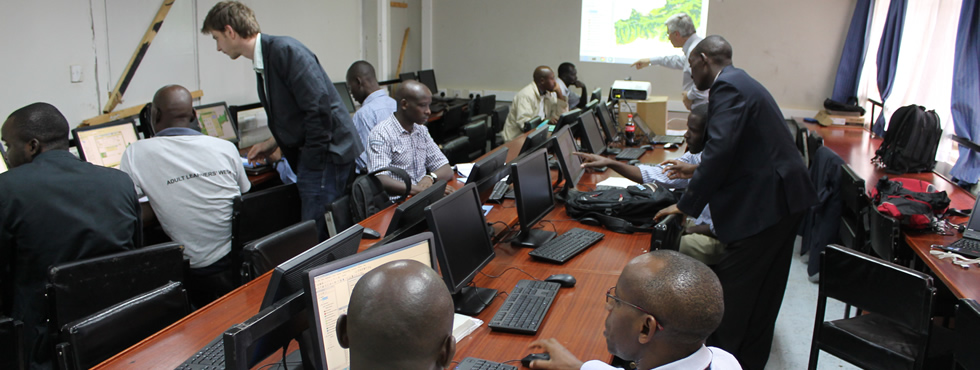
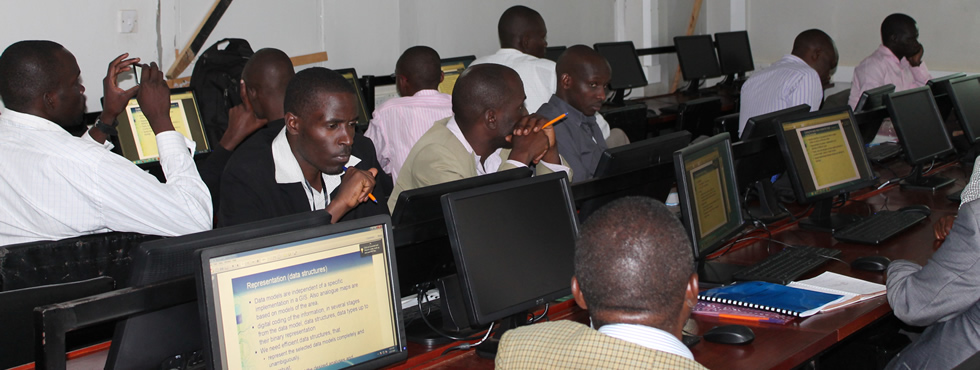
· GIS Lab Funded by ESRI
· Equipped 4 Studio rooms
· Post graduate working space fully equipped with workstation & internet – For full-time PhD Students
· Air Quality Monitoring site at City Campus
· Shared labs with other faculties
Careers & Alumini
Over the years the programme has created a network of alumni who serve in government, private sectors and NGOs at international, national and local level. The organizations include and are not limited to:
1. Development Banks ( e.g World Bank, African Development Bank – Environmental and Social Safeguard portfolios)
2. All government ministries, Departments and Agencies (Environmental Officer/ Manage/ Planner portfolio) at National level e.g NLC, NEMA, Ministry of Environment, Ministry incharge of Lands and infrastructure, KENHA, KURA, KERRA, KETRACO,GDC, KRA, KWS, KFS, WRA, etc
3. County Governments
4. UN Environment (UNEP)
5. Commercial Banks (Sustainability officers, Green Financing, Environmental Health & Safety Officer Portfolios)
6. International and Local NGOs e.g Word Vision, Nature Kenya, Red cross, IUCN etc
7. Regional government bodies such as IGAD, EAC, EU Commission office in Kenya
8. Regional organizations e.g RCMRD, LBDA
9. Research Institutions e.g KEFRI, KALRO, KEMFRI etc
10. Academic Institutions; TVET and Universities
11. International & local private firms (environmental officer/ Manager portfolio) e.g ESRI, Telecoms companies, consulting firms etc
Department of Spatial and Environmental Planning is a centre of excellence in Environmental Planning and Management programme. The Masters & PhD programmes receives funding from German Exchange Programme (DAAD) to train in-country / in-region professionals and academicians since 2015. Under this arrangement the Department has graduated over 20 PhDs and 10 are at advanced stage of their PhD & Masters programme.